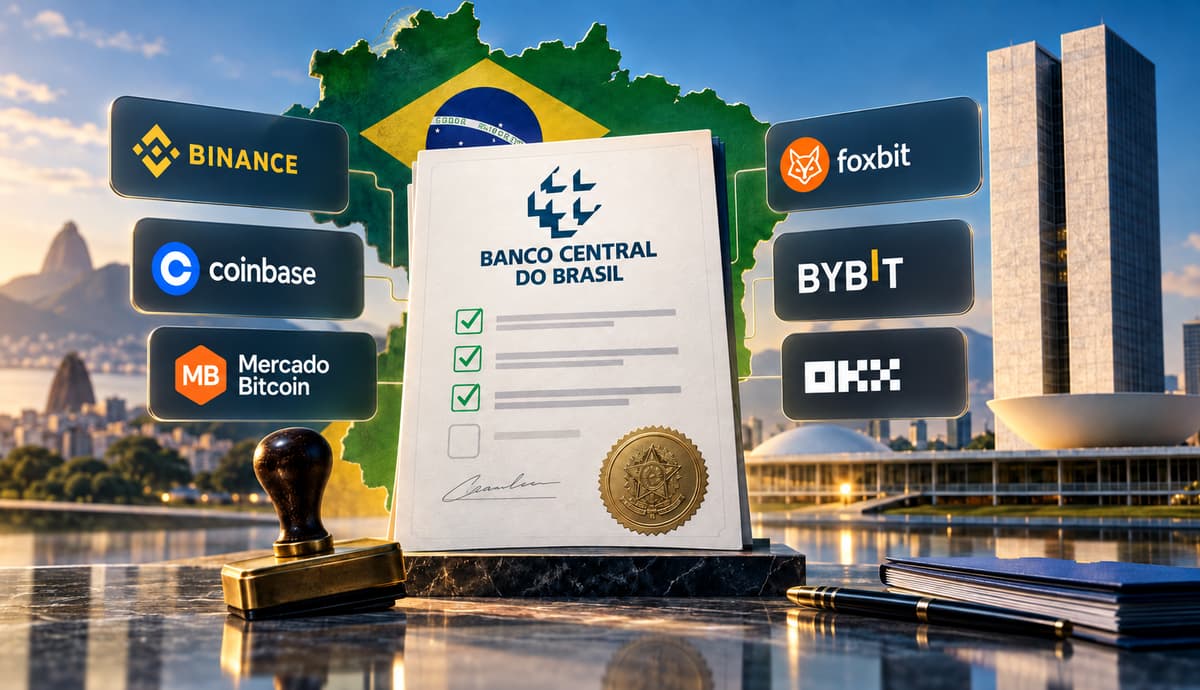
Brazil's new cryptocurrency regulation has put exchanges in front of a decision set to reshape the market in the country: apply for authorisation from Brazil's central bank, the Banco Central do Brasil, to keep operating under the new rules, or scale back, change or even wind down their activities.
Since February 2026, companies offering services such as buying and selling, intermediation and custody of crypto assets have fallen under a new regulatory regime. The rules created so-called Virtual Asset Service Providers (Sociedades Prestadoras de Serviços de Ativos Virtuais, or SPSAVs), which need authorisation from the central bank to operate.
For companies already active when the rules took effect, the central bank set a transition period. The authorisation request must be filed by 30 October 2026, according to the regulator's rules.
That process has begun splitting the Brazilian market into different groups. Some exchanges say they are already in the authorisation process or have publicly stated they will file a request. Others have decided the costs and requirements of continuing to operate are not worth it and have announced their exit from the market. There are also large platforms, mostly foreign, that continue to serve Brazilian customers without having publicly clarified how they intend to fit into the new regime.
The situation is not necessarily binary, either. Companies such as Ripio and Crypto.com, for example, have made significant changes to their products and operations in recent weeks but continue to offer at least part of their services in the country. In addition, there are other types of service beyond exchanges that will also require authorisation but fall into different situations.
Central bank deadline is already reshaping the market
Resolutions BCB 519, 520 and 521 set out requirements on capital, governance, internal controls, anti-money-laundering measures, security and segregation of client funds, among other obligations.
The impact of these requirements is already visible in the market. Coinext and Digitra have decided not to file for authorisation and have begun winding down their exchange operations. NovaDAX shut down trading back in July. Bitso, for its part, has chosen to stop offering services directly to retail customers in Brazil and has directed users to Mercado Bitcoin (MB).
Other companies have chosen intermediate paths. Crypto.com will close its real-denominated account on 25 October, including deposits, withdrawals and trading between the Brazilian real (BRL) and cryptocurrencies, but will continue to allow deposits, withdrawals and trading in crypto assets.
Ripio will also remain in the country but will stop holding balances directly in reais from 30 October. Deposits in Brazilian currency will be automatically converted into wBRL, a stablecoin pegged to the real, while withdrawals in reais will remain available via Pix, Brazil's instant-payment system. Bity has also made adjustments and announced a partnership to migrate its customers to MB.
The regulatory timetable has also seen a recent adjustment. Resolution BCB 589, published in September, determined that from 6 November 2026, financial institutions, payment institutions and other companies authorised by the central bank will no longer be allowed to carry out or facilitate transactions with virtual asset service providers outside the conditions permitted by the rules. However, the 30 October deadline for companies already in operation to file their authorisation request has been kept in place.
Where the main exchanges in Brazil stand
The table below tracks the status of the main exchanges serving, or that have served, Brazilian customers. Under “Yes” are companies that say they are in the authorisation process or have publicly stated they intend to file a request, even if this does not yet appear in the central bank's system. This also does not mean the licence has already been granted.
“No” identifies companies that have announced they will not file a request, or that are winding down the exchange/retail operation to which authorisation would apply. Exchanges marked “?” are those that have not publicly confirmed a request, do not appear in the central bank's system, and had not responded to Portal do Bitcoin's enquiries on the matter at the time of writing.
| Exchange | Authorisation | Status |
|---|---|---|
| B3 | Yes | At an industry event, director Humberto Costa said B3 will seek a broad licence from the central bank, covering custody and intermediation. |
| Binance | Yes | The company has publicly confirmed it has filed its licence request with the central bank. |
| Bipa | ? | Bipa Instituição de Pagamento is in an authorisation process with the central bank, but this is not necessarily an SPSAV request. |
| Bitget | ? | CEO Gracy Chen said the company's presence in Brazil "is long-term" and that it is in talks with regulators, but has not confirmed a request will be filed. |
| Bitso | No | Will end direct services to retail customers in Brazil by 30 October. Customers can migrate to Mercado Bitcoin. |
| Bity | No | Has also announced a partnership with Mercado Bitcoin to migrate its customers in Brazil. |
| Brasil Bitcoin | Yes | CEO Jorge de Almeida told Livecoins the company filed its official request on 15 October under the Brasil 8 corporate entity. |
| Bybit | Yes | The company said it filed its request with the central bank on 20 October. |
| Coinbase | Yes | Coinbase has stated it intends to apply for authorisation as an SPSAV. |
| Coinext | No | The exchange has confirmed it is winding down its virtual asset brokerage activity. |
| Crypto.com | No | Will continue offering cryptocurrency services but will close its real-denominated account on 25 October, ending deposits, withdrawals and direct BRL trading. |
| Digitra.com | No | The company has confirmed it is ending its virtual asset trading and custody activities in Brazil. |
| Foxbit | Yes | Foxbit has stated it will file its PSAV authorisation request within the deadline. |
| Gate.io | ? | A March report by Valor Econômico said the exchange had no plans to seek a licence in Brazil, but the company has not publicly confirmed this decision. |
| Kraken | ? | Continues to serve Brazilian customers and allows deposits in reais. Has neither confirmed nor denied it will apply for authorisation as an SPSAV. |
| KuCoin | ? | Has also not confirmed whether it will seek registration, but a March report by Valor Econômico indicated the exchange had no intention of going through the licensing process. |
| Mercado Bitcoin | Yes | Mercado Bitcoin officially states it is in the authorisation process to operate as a virtual asset brokerage with the central bank. |
| NovaDAX | No | Trading activities were fully shut down in July. |
| OKX | Yes | According to a report by Exame, the company filed its "brokerage" request on 16 October. |
| Ripio | No | From 30 October, it will stop holding balances in reais and will convert deposits into the wBRL stablecoin. |
| TruBit | ? | Continues to maintain a presence and services aimed at the Brazilian market but has not officially stated whether it will request SPSAV authorisation. |
The table above will be updated whenever there is news on each company's situation, whether through public statements, signals or direct contact with Portal do Bitcoin. This is because some of the largest platforms in the market have still not publicly disclosed whether they have filed, or intend to file, the documentation required by the central bank.
It is also important to distinguish other types of regulatory authorisation from the SPSAV licence. An exchange may belong to a group that holds a securities brokerage licence or a payment institution authorisation from the central bank without this automatically meaning its cryptocurrency activity is already authorised under the new regime.
A request to the central bank does not yet mean a licence granted
Even among companies classified as "Yes", there are important differences. Some already say publicly that they are in the authorisation process, while others have only confirmed their intention to seek the licence.
In all these cases, final authorisation depends on the central bank's review. So during the transition period, saying an exchange is "in the authorisation process" does not mean the regulator has already approved its operation under the new regime.
This distinction is likely to matter more as the process moves forward. The market that emerges at the end of the transition period could be smaller than it was before the regulation, with some companies leaving the retail segment, others cutting back on products, and those that remain operating under requirements closer to those applied to the rest of the financial system.
For this reason, the situation of exchanges in Brazil remains in flux. Going forward, the key point to watch will be which companies actually file their request with the central bank, which manage to advance through the authorisation process, and which choose to change or end their operations in the country.
If you want to invest in cryptocurrency safely, Mercado Bitcoin offers a special benefit to our readers: use the code PORTAL250 when signing up and get a 8.35 EUR bonus in Bitcoin when you buy 41.73 EUR worth of assets. Click here to open your account.