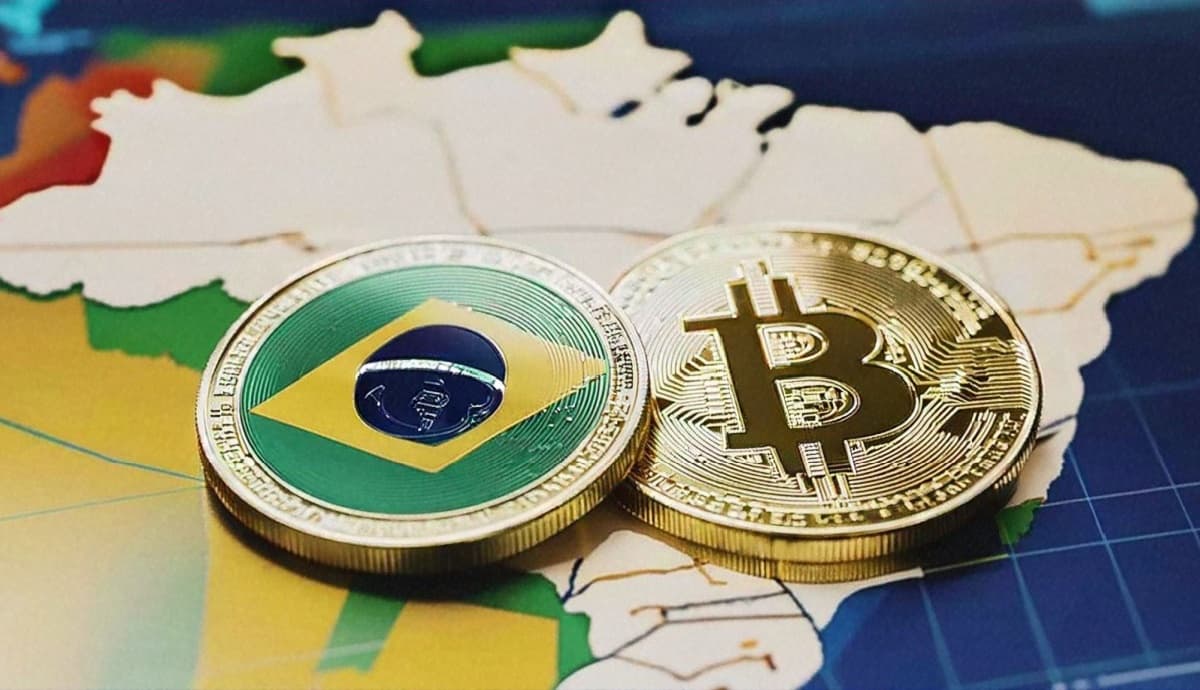
Brazilian demand for cryptocurrencies abroad rose again in September and, despite a recovery in August and September, volumes remain far below the levels seen in the first half of the year. The latest data from Brazil's central bank, the Banco Central do Brasil, show that operations involving crypto assets such as stablecoins totalled US$842.7 million in September 2026, an increase of roughly 20% from August.
The result marks the second consecutive month of recovery after the sharp drop recorded in July, when flows plunged nearly 80% amid the market's reorganisation in response to the central bank's new rules.
Despite the improvement, the volume remains 49% below the US$1.65 billion recorded in September 2025, according to the External Sector Statistics published on Monday (26th).
The recovery also remains far from pre-July levels. In June this year, flows had reached approximately US$2.6 billion. Even after two months of growth, demand is thus still around 68% below that level.
The data form part of the crypto-assets-with-corresponding-liability category, used by the Banco Central do Brasil to track international operations involving digital assets that have an issuer or an associated obligation. Stablecoins, such as USDT and USDC, are examples of this category.
Cryptocurrencies without an issuer, such as Bitcoin, are recorded separately, under the capital account of the balance of payments.
Recovery comes amid new crypto regulation
The gradual rebound follows a sharp shift in international cryptocurrency flows observed in July.
That month, volume fell from approximately US$2.6 billion to US$571.5 million, a drop of close to 80%. In August, operations began growing again, reaching US$702.3 million. Now, in September, they advanced to US$842.7 million.
When the July data were released, Fernando Rocha, head of the Banco Central do Brasil's Statistics Department, linked the drop to the market's adjustment to the new regulatory requirements.
"This reduction in transactions reflects a period of reorganisation in this virtual asset market, in a context of tighter regulation and conduct supervision by the central bank over this sector," Rocha said at the time.
The slowdown coincided with the rollout of rules governing the operations of cryptocurrency firms in Brazil, including licensing requirements, minimum capital, internal controls and rules for international transactions involving virtual assets.
Since then, several companies have announced changes to their operations. Binance, for instance, restricted the services and cryptocurrencies it offers to Brazilian users, while Revolut decided to temporarily suspend its digital asset operations in the country.
Other exchanges, including Bybit, OKX and Binance itself, have formally applied for authorisation to continue operating in the Brazilian market. The deadline for the first phase of licence applications ends this Friday (30th).
The September data show international demand beginning to respond after the initial shock, but it is still too early to say whether flows will return to pre-regulation levels.
2026 total already close to 2025's
Despite the recent declines, the cumulative volume of international operations involving crypto assets with a corresponding liability remains significantly above last year's.
From January to September, flows totalled US$16.8 billion, against US$11 billion in the same period of 2025, an increase of roughly 52%.
The figure recorded in the first nine months of 2026 is also already equivalent to about 99% of the US$16.94 billion recorded over the whole of last year.
The result mainly reflects the strong activity seen in the first half of the year, when monthly demand exceeded US$2 billion on several occasions.
Central bank data also show that operations involving crypto assets without a corresponding liability, a group that includes Bitcoin, followed a different trajectory.
In September, spending on these assets, which represents purchases made by Brazilian residents from counterparties abroad, totalled US$30.2 million, down from US$88.7 million in the same month of 2025, a drop of roughly 66%.
In the January-to-September period, this spending reached US$469.5 million, against US$797.6 million in the same period a year earlier, a decline of roughly 41%.
Revenue related to these crypto assets, on the other hand, reached US$52.2 million in September, leaving a positive balance of US$22 million in the capital account. A year earlier, the result had been negative, at US$67.9 million.
The shift shows that, although stablecoin flows have resumed growth, the international crypto asset market still shows important differences between the categories tracked by the central bank.
If you want to invest in cryptocurrencies securely, Mercado Bitcoin offers a special benefit to our readers: use the code PORTAL250 at sign-up and get a 50 EUR bonus in Bitcoin when you buy 250 EUR worth of assets. Click here to open your account.