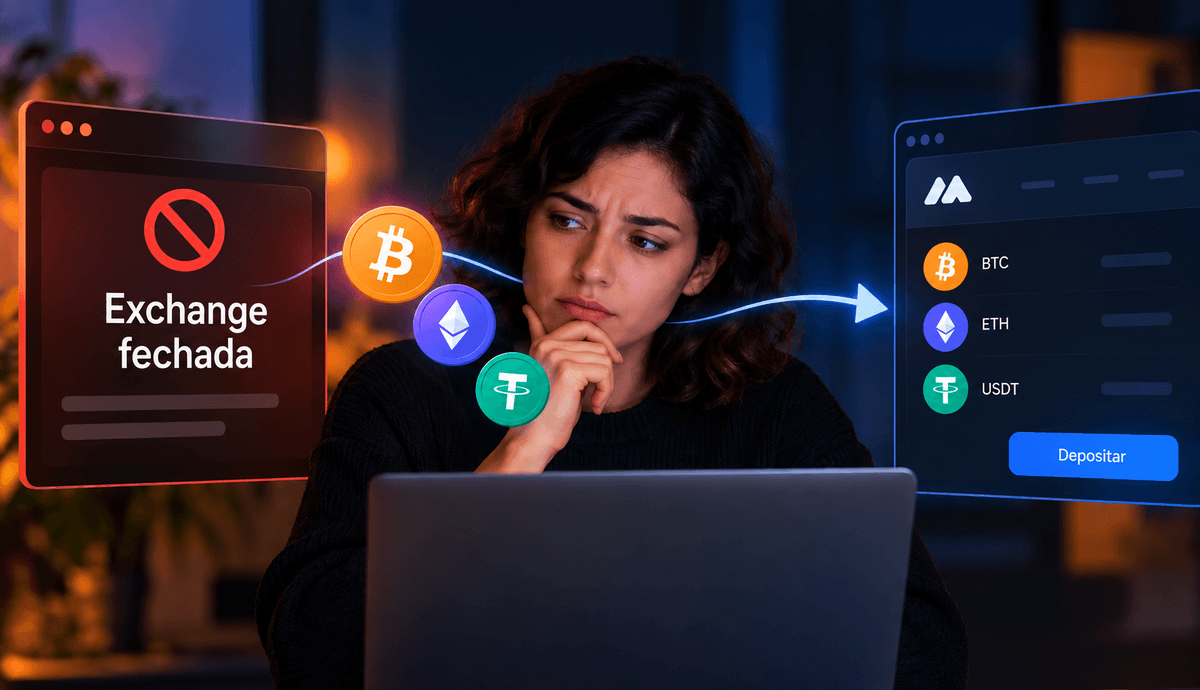
Tightening regulation from Brazil's central bank, the Banco Central do Brasil, is reshaping the country's cryptocurrency market and has already pushed some exchanges to close or scale back their operations there. For anyone still holding Bitcoin, other cryptocurrencies or a balance in reais on these platforms, the main advice is not to ignore the notices: each company sets its own timetable for withdrawals, transfers and any eventual conversion of remaining assets.
In any case, the final deadline is 30 October, the last day for firms already operating in Brazil to file for authorisation with the central bank as a Virtual Asset Service Provider, known locally as an SPSAV (Sociedade Prestadora de Serviços de Ativos Virtuais).
Firms that file within the rules can keep operating while the central bank reviews their application. If an application is later rejected or definitively shelved, BCB Resolution No. 519 requires the company to stop providing services and return clients' crypto assets and funds within 30 days of being notified of the decision.
It is this adjustment process that has led companies such as NovaDAX, Coinext, Bitso and Bity to announce changes or the closure of part of their Brazilian operations. The approaches differ: some simply opened a window for withdrawing funds, while others struck deals to make it easier for clients to migrate to competitors planning to stay in the market.
Finding out that the exchange holding your cryptocurrencies is closing does not necessarily mean losing the assets. It does mean, however, that investors need to follow the timetable closely and decide where their holdings will sit afterwards.
First step: check the exchange's deadlines
The first thing to do is check the platform's official channels and identify three dates: the last day trading is possible, the last day cryptocurrencies can be withdrawn, and the last day a balance in reais can be withdrawn. These deadlines are not necessarily the same.
Coinext, for example, is closing the window for cryptocurrency withdrawals on 30 October. Assets left on the platform will be liquidated and converted into reais. Withdrawals in reais, by contrast, will remain available indefinitely.
This detail matters because failing to act can change the composition of an investor's holdings. If an exchange plans to automatically convert Bitcoin, Ethereum or another asset into reais or stablecoins after the deadline, the investor could end up making a sale they never intended, at a price set by market conditions at that moment.
It is also worth downloading statements, receipts and trading history before losing normal access to the platform. These documents may later be needed for a tax return, for calculating acquisition cost, or to prove transfers.
Anyone choosing to move their cryptocurrencies to another exchange needs to check that the destination platform accepts exactly the asset and network used for the withdrawal. USDT sent via Ethereum, for instance, is not operationally the same transfer as USDT sent via Tron. An incorrect address or network can result in the funds being lost.
Moving to a self-custody wallet raises the stakes further: the investor takes control of the keys that give access to the cryptocurrencies. This removes the dependence on an exchange to hold the assets, but it also means that losing the seed phrase or private keys can make the funds unrecoverable.
Another concern is scams. Migration periods tend to generate messages about supposed account updates and urgent transfers. NovaDAX and Bitso, for example, have warned clients to use only their official channels and never share passwords or authentication codes.
Where to move your cryptocurrencies
Besides withdrawing to a self-custody wallet, another option is to transfer funds to an exchange planning to keep operating in Brazil under the new rules.
Some of the firms exiting the market have already arranged deals to smooth this path. Bitso, which will end its direct retail services in Brazil on 30 October, has struck a partnership with Mercado Bitcoin. Depending on each client's situation, crypto and reais balances can be transferred to the new platform through a simplified process, although registration and legal verification are still required, whether with Mercado Bitcoin or another exchange.
Mercado Bitcoin has stated publicly that it will file its applications to operate as a virtual asset service provider and in the foreign exchange market within the regulatory deadline.
The existence of a partnership, however, does not oblige a client to pick the exchange on offer. When choosing a new exchange, fees are only one factor. With the central bank now supervising the sector, it matters more which legal entity will provide the service in Brazil, whether it intends to seek the required authorisation, how custody works, whether client funds are segregated from the company's own, and what security and support procedures are in place.
The new regulation makes that last point especially relevant. BCB Resolution No. 520 requires service providers to keep clients' funds separate from their own and to adopt mechanisms to segregate crypto assets as well, including custody policies and proof-of-reserves procedures.
It is also worth distinguishing between an exchange that has announced it intends to apply for authorisation and one that has already been granted it. Filing an application starts a review process at the central bank and is not an automatic approval.
For investors, the consolidation of the market calls for a relatively simple response, but one that should not be put off: check the status of the platform holding your funds, respect the published deadlines, keep a record of your transaction history, and make a conscious decision on whether to move assets to another company or take on self-custody.
An exchange leaving the Brazilian market does not, on its own, mean losing cryptocurrencies. The biggest risk for clients is letting the deadline pass without understanding what the platform will do with the assets left in the account.
If you want to invest in cryptocurrencies safely, Mercado Bitcoin offers a special benefit for our readers: use the code PORTAL250 when registering and get an 8 EUR bonus in Bitcoin when you buy 42 EUR worth of assets. Click here to open your account.