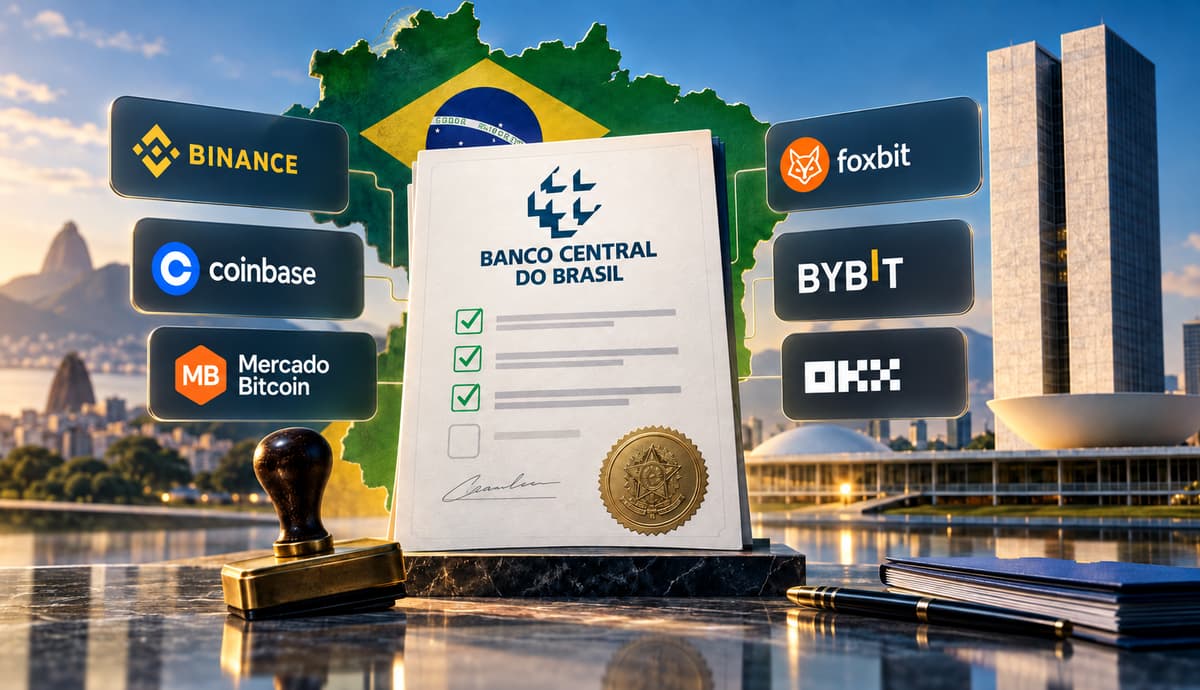
Crypto market regulation in Brazil is entering one of its most important phases. Firms that were already offering services involving virtual assets before the rules took effect have until 30 October 2026 to submit the first phase of their authorisation request to Brazil's central bank, the Banco Central do Brasil.
The changes are part of the crypto asset regulatory framework approved in 2022 and detailed by the Banco Central in November 2025. The main rules took effect in February this year and set out requirements for exchanges and other firms in the sector, including minimum capital, security, internal controls, protection of client funds and anti-money-laundering measures.
The regulation also brings changes to how cryptocurrencies are moved, particularly for operations involving stablecoins, international transfers and digital wallets that remain under investors' own control.
With so many changes, questions have arisen over what will actually be allowed. Will the central bank be able to control Bitcoin wallets? Will foreign exchanges be banned? Will there be new taxes? Will investors' funds come under the same guarantee offered to bank customers?
Some of these concerns relate to rules that have already taken effect, while other changes will only apply in the coming months. There is also misinformation about the scope of the regulation, which focuses mainly on firms that provide crypto asset services, not on how the blockchains themselves operate.
To clarify these points, here are ten myths and facts about Brazil's new crypto regulation and what actually changes for people who invest in Bitcoin and other cryptocurrencies.
Five myths about the new crypto regulation:
Will the central bank control or ban Bitcoin in Brazil? (MYTH)
The new regulation does not ban buying, selling or holding Bitcoin and other cryptocurrencies in the country. Nor does the Banco Central take direct control of the Bitcoin network, set its operating rules or gain access to investors' private keys. The regulator's responsibility lies mainly in authorising and supervising firms that offer services involving virtual assets, such as exchanges and custodians.
This distinction was highlighted by Henrique Vincentin Lisboa, a lawyer at the VBSO firm. According to him, "the focus of the regulation is on the intermediary" — that is, on the firms that serve clients, hold cryptocurrencies or execute transactions. The blockchains therefore keep running independently of the central bank, although the companies offering related services need to meet Brazilian requirements.
As Vanessa Butalla, Chief Legal, Compliance and Risk Officer at Mercado Bitcoin, also points out, the new regulation does not mean the central bank will start controlling Bitcoin or interfering in how it works. "The rules apply to the companies that offer services with crypto assets, such as buying, selling and custody, not to the asset itself, which runs on a decentralised network. The goal is to ensure these companies follow standards of security, transparency and risk management, offering investors more protection," she says.
Will holders of Bitcoin in self-custody be forced to move it to an exchange? (MYTH)
Investors will be able to keep holding their cryptocurrencies in their own wallets, an arrangement known as self-custody. Under self-custody, the user directly controls the private keys that allow assets to be moved, without relying on an exchange. This includes wallets installed on computers or phones and physical devices designed to store cryptocurrencies, known as hardware wallets.
What changes are the obligations of the platforms involved in transfers. When a client sends Bitcoin from an exchange to a self-custody wallet, for example, the firm may need to identify the owner of the address and verify information about the origin and destination of the funds. These requirements do not give the central bank control of the wallet, nor do they by themselves block transactions carried out directly between users.
Did the new regulation create a tax on all crypto purchases? (MYTH)
The Banco Central's resolutions did not create a new general tax on buying Bitcoin, Ethereum or other cryptocurrencies. The regulator has the authority to govern firms and certain financial operations, but it cannot freely create new taxes through these resolutions. That does not mean crypto asset transactions are tax-exempt: gains from investments are already subject to the applicable tax rules, depending on the nature and conditions of each operation.
The main debate concerns stablecoins pegged to foreign currencies, such as USDT and USDC. As certain operations with these assets now fall within the foreign-exchange market, questions have arisen over whether Brazil's financial transactions tax, the IOF, applies. Experts note that stablecoins are not fiat currencies and that tax treatment should consider the nature of the operation, not merely its resemblance to a traditional foreign-exchange transaction. It is therefore not accurate to say that every crypto purchase now automatically carries a new tax, although the tax consequences of specific operations need to be assessed separately.
Is an exchange that applied for a licence from the central bank already authorised to operate? (MYTH)
Submitting an authorisation request is only the start of the central bank's review process. Firms must submit documents, prove they have adequate structures in place and demonstrate compliance with regulatory requirements. The regulator may request additional information and, once the review is complete, grant or refuse authorisation. An exchange that has announced it filed its request should therefore not be presented as an institution that has already received a definitive licence.
There is, however, a transition regime for firms that were already operating when the regulation took effect. Those that submit their request within the deadline may continue providing permitted services while the review is under way, subject to conditions set by the central bank. Institutions that do not apply for authorisation will be subject to wind-down rules and restrictions on their relationships with financial and payment institutions. For investors, it is important to distinguish between a firm that has announced its intention to apply for authorisation, one that has actually filed the request, and one that has already received the regulator's approval.
Will Bitcoin and other cryptocurrencies be covered by Brazil's deposit guarantee fund after the regulation takes effect? (MYTH)
The new regulation does not turn Bitcoin into an investment protected by Brazil's deposit guarantee fund, the Fundo Garantidor de Créditos (FGC) — a scheme comparable to deposit guarantee schemes in Europe, which covers certain deposits and investment products offered by member financial institutions, such as savings accounts and bank-issued fixed-income certificates, within the limits set out in its rules. Even if an exchange receives authorisation from the central bank, that does not mean clients' cryptocurrencies will carry a reimbursement guarantee similar to bank deposits.
The new rules do set out other forms of protection, such as segregating client funds and assets from those belonging to the firms themselves, custody requirements, proof-of-reserves and audits. These mechanisms aim to reduce the risk of misuse of funds and improve the ability to spot problems at platforms. They do not, however, eliminate the possibility of losses, whether from falls in the value of cryptocurrencies, operational failures, fraud or an institution's financial difficulties.
Five facts about the new crypto regulation:
Will foreign exchanges also need authorisation to serve Brazilian clients? (FACT)
The regulation is not limited to crypto exchanges founded in Brazil. Foreign firms that want to keep providing regulated services to Brazilian clients also need to operate through a structure that complies with the central bank's requirements. This helps explain why international exchanges such as Bybit and OKX have announced authorisation requests and investment in their Brazilian operations.
The requirements include a governance structure, staff responsible for areas such as compliance and risk management, minimum capital and security mechanisms. Vanessa Butalla, Chief Legal, Compliance and Risk Officer at Mercado Bitcoin, has already noted that maintaining these structures represents an ongoing cost for firms. The change does not mean, however, that Brazilians are automatically barred from holding accounts abroad or keeping cryptocurrencies outside the country. What the regulation governs is the provision of services in the Brazilian market.
Will transfers above US$10,000 to self-custody wallets need to be reported to Brazil's financial intelligence unit? (FACT)
One of the changes introduced by the central bank is a specific reporting requirement to Brazil's financial intelligence unit, the Conselho de Controle de Atividades Financeiras (Coaf), for crypto asset transfers involving self-custody wallets equal to or above the equivalent of US$10,000. The requirement was set out in Resolução BCB No. 588, published in September, taking effect from 1 October 2026.
The reporting obligation falls on the regulated institutions, not on the investor, and does not mean the investor is doing anything wrong or that the transfer is automatically blocked. The aim is to widen the ability to monitor operations involving wallets controlled by users themselves, where oversight can be harder than with accounts held at regulated institutions. The rule does not create a general obligation to report directly to Coaf for every transfer made between two personal wallets without the involvement of an institution covered by the regulation.
Could some crypto withdrawals be held back for up to 24 hours? (FACT)
From 1 January 2027, virtual asset service providers will have to apply precautionary hold mechanisms to certain operations directed to self-custody wallets or crypto firms abroad. The measure is set out in Resolução BCB No. 584 and covers, among other situations, funds received above the equivalent of US$10,000, whether considered individually or as the client's total daily volume.
In practice, this means some transfers could go through a review period of up to 24 hours before being completed. The hold does not amount to a permanent freeze on funds and can be lifted early under the criteria set out in the regulation. The aim is to allow firms to spot suspicious activity and prevent funds from fraud being quickly moved to wallets or platforms where recovering them would be harder.
Could exchanges stop offering stablecoins such as USDT and USDC? (FACT)
The regulation could lead some platforms to restrict or change the services they offer with stablecoins, particularly those pegged to the dollar. This is because Resolução BCB No. 521 brought certain virtual asset operations within foreign-exchange market rules. Depending on the activity, a firm will need to meet additional requirements and hold the necessary authorisations to offer the service.
In practice, an exchange may be licensed to trade Bitcoin and other cryptocurrencies but not necessarily to carry out every operation involving stablecoins or international payments. This could lead firms to withdraw certain products, restructure their operations or seek partnerships with authorised institutions. The regulation does not, however, impose a general ban on USDT, USDC or other stablecoins in Brazil. What changes are the conditions required of the firms offering these services.
Will exchanges be able to ask clients for more information before transferring cryptocurrencies? (FACT)
Platforms will need to meet broader identification and monitoring requirements for virtual asset operations. One of the changes involves the so-called Travel Rule, an international standard requiring the sharing or retention of information about senders and recipients of transfers. For self-custody wallets, firms will also need to adopt procedures to identify their owners and verify the origin and destination of funds, depending on the operation involved.
For clients, this could mean new questions during deposits and withdrawals, requests for documents, and the need to provide details about the recipient or the purpose of certain transfers. This information will be used by firms to meet anti-money-laundering obligations, monitor risk and report to the authorities. So while investors will still be able to move their cryptocurrencies, some operations may require more verification steps than before the regulation.
If you want to invest in cryptocurrencies securely, Mercado Bitcoin offers a special benefit for our readers: use the code PORTAL250 when signing up and get a €8 bonus in Bitcoin when you buy €42 worth of assets. Click here to open your account.