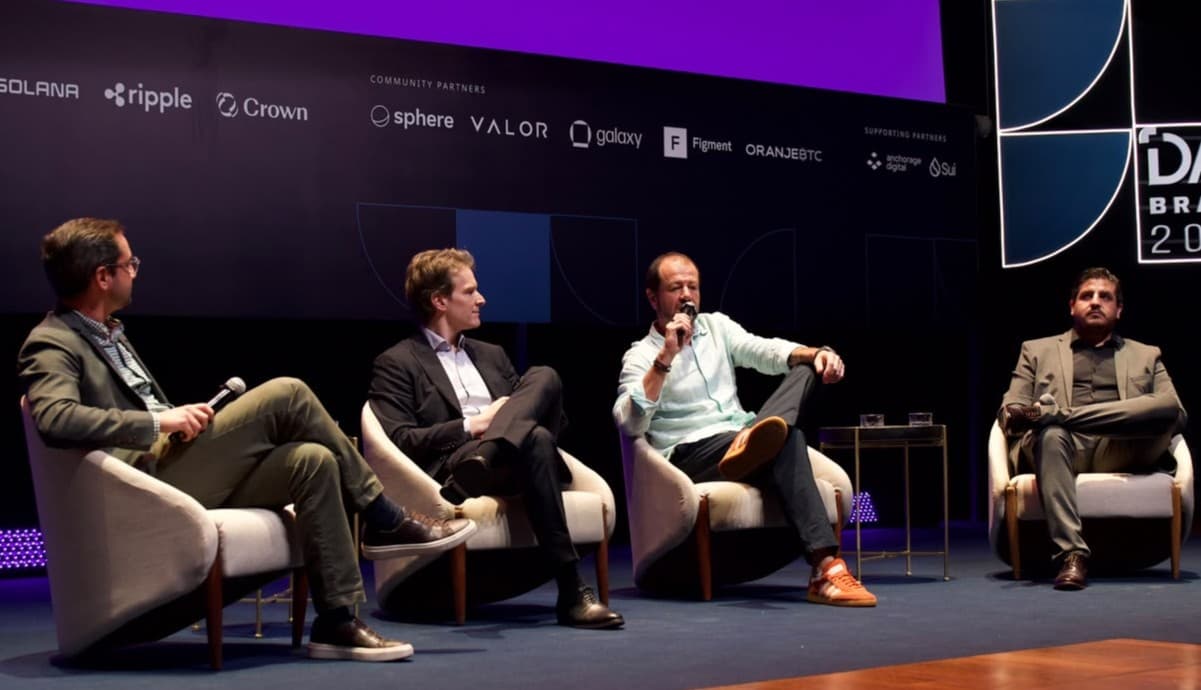
The market for stablecoins pegged to the Brazilian real could reach 1 trillion reais (roughly 169 billion euros) in circulation within the next decade, according to John Delaney, co-founder and CEO of Crown, issuer of the BRLV token. The projection was presented during a panel at the Digital Assets Conference (DAC), an event organised by Mercado Bitcoin, in a discussion on the evolution of stablecoin use in Brazil and worldwide.
Delaney argued that Brazil has favourable conditions for this market's growth: a significant local currency, a developed financial system, high interest rates and a regulatory environment that, in his assessment, has been receptive to innovation.
According to the executive, if real-pegged stablecoins reach something close to 8% of Brazil's monetary base within ten years, the market could hit the 1 trillion reais mark.
The thesis draws on a comparison with the growth of dollar-pegged stablecoins. Delaney said that only a small share of dollars in circulation is currently represented in stablecoins, but he expects that percentage to keep growing as more assets and operations migrate to tokenised infrastructure.
In his view, Brazil has an additional advantage: it is not a dollarised economy. This leaves room for a stablecoin denominated in local currency to gain its own use case, rather than functioning merely as a digital substitute for the dollar.
Delaney also noted that the real remains an attractive currency for investors when the effect of interest rates is taken into account. Although it has lost value against the dollar in recent years, the yield offered by local interest rates can offset part of that depreciation for those able to access that return.
Stablecoins already dominate a significant share of crypto volume
The growth of stablecoins in Brazil is already visible in trading volumes, according to Fabricio Tota, director of New Business at Mercado Bitcoin.
Tota said that in 2019, stablecoins accounted for around 3% of reported trading volume in Brazil. Today, that share exceeds 80%, according to figures he cited during the panel.
He also said that nearly 90% of that stablecoin volume is concentrated in Tether (USDT).
The way these assets are used has also changed. In the early years, stablecoins were used mainly as a trading instrument within the crypto market. Later, they gained traction as a simpler way to gain exposure to the dollar.
At Mercado Bitcoin, according to Tota, that remains the main use by number of users: people buy stablecoins to hold exposure to the US currency, not necessarily to make payments or transfers. Among institutional clients, however, use as infrastructure for moving funds is already more significant.
Rodrigo Stallone, head of institutional business for Tether in Latin America, summarised this evolution in three phases: first, stablecoins as a trading tool; then, as an instrument for different use cases; and, more recently, as infrastructure adopted by institutions.
Next step is becoming 'invisible' infrastructure
For the panel participants, future expansion of stablecoins may occur precisely when users stop noticing they are using this type of asset.
Tota gave the example of a purchase made in Argentina via Pix. For the consumer, the experience felt like a conventional payment, but the infrastructure behind the transaction used USDT.
According to him, this is the kind of use that should gain ground: the technology working behind the scenes, without requiring the consumer to have a crypto wallet or know anything about blockchain.
"The good story is when someone pays using a stablecoin and doesn't even know it," Tota said during the panel.
This view also ties in with the advance of tokenisation. Stallone said Tether intends to act as a settlement layer not only for transactions involving crypto assets, but also for tokenised products.
Delaney echoed that view. According to him, if shares, funds and other assets migrate onto blockchain networks, there will need to be a form of tokenised money to settle those transactions. In that scenario, stablecoins would stop being just an alternative for payments and become part of financial market infrastructure.
Regulation remains a challenge for expansion
Despite the growth, participants pointed to regulatory fragmentation as one of the main obstacles to faster global expansion.
Juan Pablo, an executive at Sphere, said different countries still adopt their own rules for stablecoins and other crypto assets, which makes it harder to build products that scale internationally.
According to him, Latin America could benefit from a more harmonised regional standard for compliance and supervision, especially since stablecoin payments already operate globally — a challenge not unlike the one Europe has sought to address through MiCA and coordination among national competent authorities.
For the coming years, he expects governments to resume discussions on specific rules for these assets and for stablecoins to gain further ground in remittances and international payments, mainly because they offer faster settlement.
In Brazil, this progress is expected to occur alongside the consolidation of new regulation for the virtual asset market and the growth of tokenisation. For the panel participants, the next stage will be less about convincing users to buy stablecoins and more about integrating them into financial infrastructure without consumers needing to know they are there.
Looking for a way to boost your returns? Mercado Bitcoin's tokenised fixed income is the solution: up to 18% annual return, controlled risk and the security your money deserves. Find out more!