
In recent years, thousands of new cryptocurrencies have emerged, each claiming to offer something slightly different. Bitcoin was the first, and its value rose to around US$ 20,000 by the end of 2017, before plunging more than 60% in early 2018.
Bitcoin took three years to return to its previous peak, and by the end of 2020 it had doubled in value in under a month. In 2021, large companies began investing, and notable Wall Street sceptics changed their minds.
Now, in 2025, 1 Bitcoin is worth more than 99,720 EUR, and it is becoming impossible to ignore cryptocurrencies.
But let's focus more closely. What are cryptocurrencies, how do they work, and why do people take such an interest in them? You are in the right place to find out.
What is a cryptocurrency?
A cryptocurrency is a purely digital token. It uses cryptography (hence the shortened name, “crypto”) to govern how tokens are created, how they are traded and how secure they are. And — here is the main draw for many — it does not use or need a central bank or government to control or manage it.
Bitcoin was the first cryptocurrency, created by a person (or people) using the pseudonym Satoshi Nakamoto, and was first described in October 2008 in a whitepaper that called the concept “A peer-to-peer electronic cash system”. Bitcoin's blockchain, the network on which BTC runs, launched in January 2009. (Today, many other blockchains exist.)
In essence, cryptocurrencies are:
- Digital: Cryptocurrencies are entirely native to the internet. You cannot touch or physically hold them. (Yes, those illustrations of bitcoins as physical gold coins with a B on them can be misleading.)
- Decentralised: all cryptocurrency transactions are stored on a public, global list or ledger. This means records are stored in several different locations (nodes) at once.
- Peer-to-peer: cryptocurrencies are exchanged between parties electronically, without the need for a central party or intermediary to approve the transaction.
How are cryptocurrencies created?
Most cryptocurrencies (though not all) generate new units or coins through the process of mining. In this process, individuals or groups (miners) use expensive computers that race to solve cryptographic puzzles in order to verify sets of transaction records (blocks) on the ledger.
Miners are rewarded for their efforts with newly created coins. (On the Bitcoin blockchain, the mining reward is halved every four years in a process called 'halving', a measure to slow the creation of new bitcoins.)
How are cryptocurrencies being used?
Today, there is debate over whether cryptocurrencies really behave like money or are treated more like commodities. (Some argue they should be called “digital assets” rather than cryptocurrencies.)
But cryptocurrencies were not created only to be an alternative to the dollar or any other national currency. They can be used for many different things. These are just three examples of coins that followed Bitcoin:
- Litecoin – the Litecoin blockchain was created in 2011 as a hard fork of the Bitcoin blockchain; its creator, Charlie Lee, intended it to be silver to Bitcoin's gold. Its token is LTC.
- Ethereum – the Ethereum blockchain launched in 2015 and was designed specifically to power decentralised applications (dApps) and smart contracts on its network. Its token is Ether, or ETH.
- Filecoin – the Filecoin network, launched in 2020, allows people to rent out storage space on computers, similar to Dropbox, for the decentralised web. Its token is FIL.
Bitcoin was invented to be a form of digital money, but cryptocurrencies have since become more sophisticated.
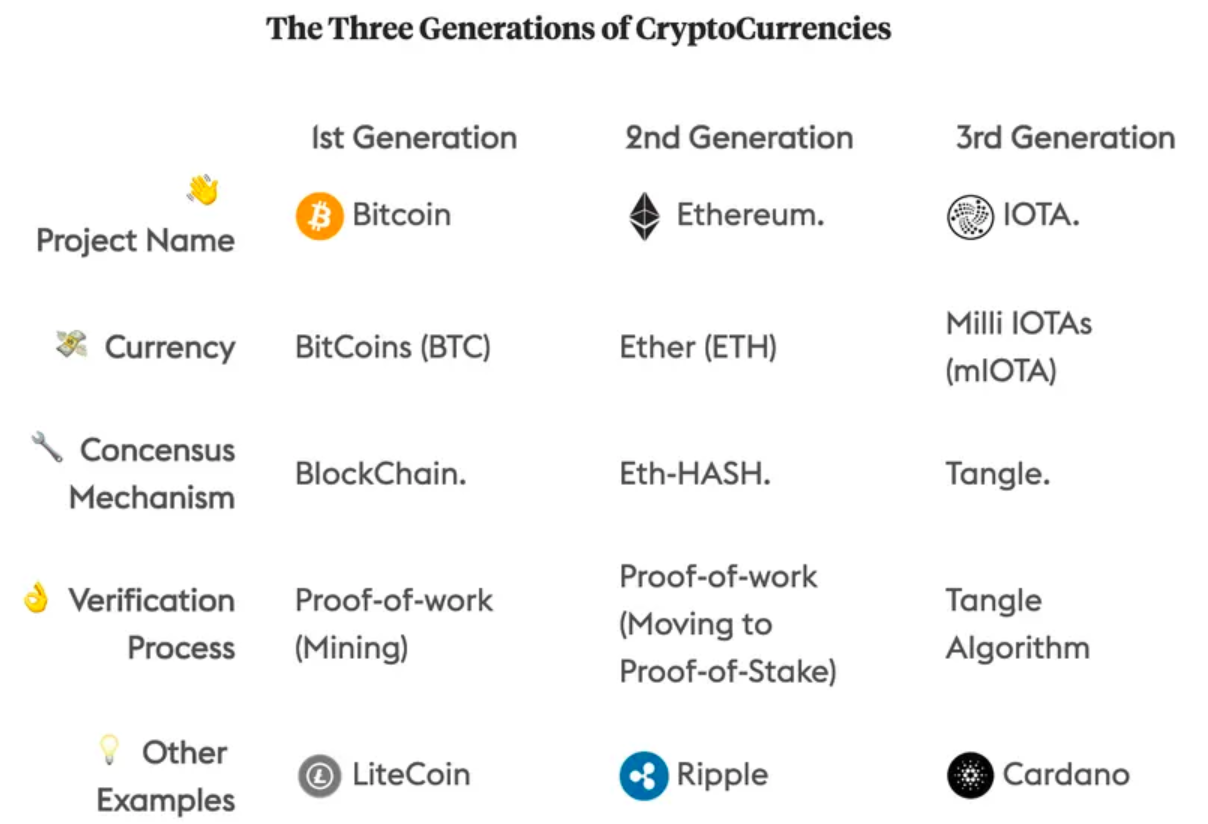
The evolution of cryptocurrencies has been so rapid that, to help you understand how it has developed, we have put together this table showing how some of the largest cryptocurrencies are trying to solve different problems.
Why are there so many cryptocurrencies?
Bitcoin was the first cryptocurrency and solved some of the main problems of creating digital money. But it was not without flaws. As a result, developers, entrepreneurs and programmers have set out to build cryptocurrencies that meet a variety of needs and solve different problems.
What is the appeal of cryptocurrencies compared with government-issued currencies?
- They are semi-anonymous. Cryptocurrencies can be designed so that no one can see who you are or what you are spending your cryptocurrency on — though the transactions associated with a wallet address are publicly visible.
- They are not controlled by a government. People in unstable countries, where currencies are volatile, can use cryptocurrencies as an alternative way to buy goods and services.
- They have no borders. Like the internet, cryptocurrencies can go anywhere.
- They are more secure. Distributed ledgers are very difficult to hack, since no single centralised party is in control.
- Transactions are cheaper and faster. Although crypto exchanges charge fees for buying, selling or transferring your cryptocurrency, these fees tend to be far lower than the cost of transferring money across borders in the traditional financial system — and transactions are verified much more quickly.
- They can be used to execute contracts. Cryptocurrencies are not used only as a form of money. They can also be used to store contracts between people and execute them automatically.
The future
We are still at the beginning of the cryptocurrency era. Many coins will appear and disappear, and some will become incredibly valuable, while others may fall to zero.
But cryptocurrencies as a whole, along with the technology and industry around them, are here to stay.
* Translated and edited with permission from Decrypt.